Check out the latest issue of our magazine.
Check out the latest issue of our magazine.
By Kit Werner, Senior Director of Communications
Say the word “prairie,” and most of us picture the vast plains of the Midwest. In contrast, the northeastern U.S. is the land of would-be woods, where every farm field and meadow quickly reverts to forest without intervention. Yet early accounts of this region—“Penn’s Woods,” as colonists named it—reveal a far more nuanced picture of Pennsylvania’s native ecology. One that included thriving eastern prairies that evolved with fire.
Some 400 years ago, English explorers of the North American continent were met with awesome expanses of grasslands. With no word for this habitat type, they adopted the French term for meadow: prairie.
Contrary to the common belief that the northeastern U.S. was once entirely forested, historical accounts depict tall meadows and broad savannahs tended with fire by Indigenous communities. Regional placenames are another clue. Southwest Philadelphia’s Kingsessing is derived from the Lenape word for “place where there is a meadow.” The Wyoming Valley region around Wilkes-Barre takes its name from a corruption of the Indigenous word for “great meadows.”
Eastern prairies have long disappeared throughout their range in the face of farming and development. The removal of native people and their millennia-old relationships with the land—particularly, their seasonal controlled burns that held back trees and regenerated the grasslands—have further ensured the decline of these unique meadow ecologies.
On Natural Lands’ nature preserves, however, prairies are making a big comeback.
“Over the past decades, we’ve converted almost 1,000 acres of former farm fields to native grassland meadows,” said Gary Gimbert, vice president of stewardship. “
In 2025 alone, we installed meadows at ChesLen and Diabase Farm Preserves with a focus on pollinators, birds, and other wildlife that rely on this type of habitat for food, nesting, and—in the case of raptors—hunting sites.”
Grasslands are of particular importance to several species of native songbirds—including Bobolink, Eastern Meadowlark, and Grasshopper Sparrow—that build their nests on the ground, tucked between clumps of meadow grasses. With more and more land lost to development each year, grassland birds are really struggling, having lost a third of their numbers in the last half-century.
Meadows are also home to a vast array of nectar-rich wildflowers that support our native pollinators: bees, butterflies, moths, wasps, beetles, and flies.
“Over the years, we’ve learned a lot about how to create thriving meadows,” said Gary. “We can’t just plant grass and wildflower seeds and walk away. Meadows take regular maintenance, or they’ll be filled with invasives and eventually become forests.”
One important technique Natural Lands uses to keep its meadows healthy is fire. For 25 years, prescribed burns have been part of the organization’s comprehensive approach to land stewardship.
Many meadow species have evolved not only to withstand but also benefit from periodic burning. Two native grasses, big bluestem (Andropogon gerardii) and little bluestem (Schizachyrium scoparium), respond to fire by sprouting substantially more growth and setting more seeds. Fire stimulates the underground rhizomes of Indian grass (Sorghastrum nutans) and switchgrass (Panicum virgatum).
The secret to these and other native grasses’ survival of fire is their deep roots; three quarters of the plant is underground. The visible plants are merely the photosynthetic leaves gathering sunlight. These deep roots make meadow plants valuable carbon sinks. Unlike forests, they don’t release that carbon when burned because most of the plant material is under ground.
“The results speak for themselves,” said Darin Groff, director of land stewardship and burn boss for Natural Lands’ prescribed fire crew. “We walk away from a burn with the plants charred black. But very quickly after, you can see life—meadow grasses sending up new shoots, seedlings sprouting, hawks circling overhead.”
Added Darin, “Controlled burns aren’t a short-term fix. Meadow management takes ongoing effort from our land stewardship team.”
Fortunately for the birds, bees, butterflies, and blooms, Natural Lands is in the business of forever and will keep tending the remaining eastern prairies in our care.
benefits of prescribed fire.
- Helps control the encroachment of woody plants and the growth of invasive species
- Helps remove the buildup of dried plant material, which reduces the risk of wildfires
- Improves the release of nutrients from dead plant material so that they can be recycled through the ecosystem
- Warms the soil in early spring by allowing more sunlight to reach the ash-darkened ground, increasing microbial activity, further helping to release nutrients from dead plant matter
- Improves and increases food and cover for wildlife, as new growth flushes after fires and attracts grazing animals
- Improves plant diversity
training & testing before ignition.
by Fateen Stafford, 21st Century Conservation Fellow
On an early morning in April, a crew dressed in yellow and green wildland fire gear starts prepping its equipment. The drip torches are refueled, the backpack pumps are checked for any leakage, and the hand tools are sharpened. All these items are loaded onto the back of trucks and all-terrain vehicles that have been specially outfitted with water tanks, pumps, and a few hundred feet of hose.
This is the start of a burn day at one of Natural Lands’ meadows.
But long before the first blades of grass are ignited, Natural Lands stewardship staff goes through significant training to be certified in the use of prescribed fire.
The process starts with study—about 40 hours of it to pass five courses covering equipment and terminology, the Incident Command System, and working with peers in a high-risk environment. Each year, the Natural Lands fire crew participates in this training, which culminates in a Work Capacity Test. Every participant must walk two miles in 30 minutes with a 25-pound vest on, to simulate the weight of fire-fighting gear. A Field Test requires physical demonstration of all the skills learned online.
After my training this past spring, I had the confidence to use the drip torch to light a section of meadow at ChesLen Preserve, use hand tools to scrape back the dried winter grass so that the fire would be contained when it hit the bare soil, and “mop up” at the end of the burn by spraying down smoldering areas.
So, the next time you visit a Natural Lands meadow, you’ll have a little sense of the work that goes in to keeping these habitats healthy. One fire at a time.
MEDIA, Pa., October 31, 2025 – Natural Lands announced today the addition of two adjacent, undeveloped parcels totaling 102 acres to its Bryn Coed Preserve in Chester Springs, Chester County. The newly acquired lots bring the total acreage of the nature preserve to just over 612 acres. The properties will be stewarded to benefit native plants and wildlife.
In the 1970s, the Dietrich family assembled the vast acreage known as Bryn Coed Farms one parcel at a time. One of these tracts was the former homestead of U.S. Supreme Court Justice Owen J. Roberts, who named his farm “Bryn Coed,” which means “wooded hill” in Welsh.
Many worried over the fate of the pristine farmland and forests—located just 30 miles northwest of Philadelphia—as development pressures increased in the region. In 2018, Natural Lands acquired the entirety of the 1,505-acre property to protect it from large-scale development. The organization created a 510-acre nature preserve at the heart of the property and partnered with West Vincent Township, which created the 72-acre Opalanie Park immediately adjacent to the preserve. Natural Lands preserved the remainder of the land by selling large-acreage lots, each under permanent conservation easement, to conservation-minded buyers.
Donors who wish to remain anonymous have gifted two of those lots back to Natural Lands to increase the size of the preserve and, ultimately, to make more of this important landscape available for public recreation. The parcels consist of gently rolling fields, forest, and hedgerows.
Said Natural Lands President Oliver Bass, “Saving Bryn Coed was the chance of a lifetime, and we’ve benefitted mightily from the support of devoted partners, funders, and donors. This extraordinary gift of an additional 102 acres will expand both the footprint and the benefits of the preserve for generations to come.”
He added, “I have such respect for Preserve Manager Darin Groff and Assistant Preserve Manager Caleb Arrowood, who have transformed Bryn Coed into a thriving nature preserve filled with native plants. They will steward these new parcels with the same care and passion, and we’ll all reap the benefits of their work.”
“It’s very exciting to add additional acreage to the preserve,” said Darin Groff, director of land stewardship. “Over the next couple of years, we will be planting wildflower meadows for pollinator habitat and additional grasslands, and work to connect wooded areas to one another by planting additional trees.”
Natural Lands is dedicated to preserving and nurturing nature’s wonders while creating opportunities for joy and discovery in the outdoors for everyone. As the Greater Philadelphia region’s oldest and largest land conservation organization, Natural Lands—which is member supported—has preserved more than 136,600 acres, including 40+ nature preserves and one public garden totaling more than 23,600 acres. About five million people live within five miles of land under the organization’s protection. Land for life, nature for all. natlands.org.
Please note: “Natural Lands” is the organization’s official operating name and should be used instead of its legal designation (Natural Lands Trust, Inc.).
Media Inquiries:
Kit Werner, Senior Director of Communications
610-353-5587 ext. 267
###
Check out the latest issue of our magazine.
Check out the latest issue of our magazine.
MEDIA, Pa., December 2, 2024 – Natural Lands announced today the conservation of the 14.4-acre Shillelagh Farm in Silver Spring Township, Cumberland County. The property offers essential habitat for wildlife, helps protect the quality of Hogestown Run, and helps mitigate the effects of a warming climate.
Shillelagh Farm consists of both woodland, agricultural fields, and floodplain. About 1,050 feet of Hogestown Run meanders through the eastern edge of the property. The land adjacent to the stream—which the landowner, Starr Offenger, has committed to leaving as a vegetated buffer—helps absorb and filter floodwaters during storms.
The property is now protected by a conservation easement held by Natural Lands, the region’s oldest and largest land conservation nonprofit. This perpetual, legally binding agreement ensures the farm will remain undeveloped forever.
“Starr and Howard Offenger’s efforts to conserve Shillelagh Farm will forever keep this remnant of Silver Spring Township’s agrarian heritage open for farming and wildlife,” said Land Protection Project Manager Robyn Jeney. “The landowners’ willingness to ensure the permanence of a naturally vegetated buffer along Hogestown Run will help to preserve and protect water quality as well as secure a meaningful corridor for wildlife habitat. It’s truly rewarding to see their conservation vision realized.”
In the early 2000s, after nearly three centuries of agricultural use, the area around the Offenger property began to be developed for residential, commercial, and industrial uses. To the east, the Property is bordered by the expanding residential and commercial development in the village of Hogestown, and to the west, by warehouses and numerous car dealerships. As a result, Shillelagh Farm is one of few remaining historical farmsteads in this part of Silver Spring Township.
“I could never in good conscience let this sacred land become another car lot or warehouse, which now surround our boundaries,” said landowner Starr Offenger. “It is a little piece of paradise for the wildlife to enjoy. It is indeed very calming to look out over the meadow and enjoy the beauty. I am glad for the opportunity to preserve!”
Silver Spring Township funded this conservation project.
Said Silver Spring Township Supervisor Laura Brown, “When the current owner’s father, Bud Gaskin purchased the farm in 1965, he planted more than 5,000 trees on the property. The foresight of Starr’s father allowed this land to stay protected and helped ensure it as an oasis for people and wildlife in the midst of rampant development. Silver Spring Township is proud to fully fund the preservation of Shillelagh Farm. With the completion of this project, the Township has now preserved more than 792 acres of farmland and woodland through our municipal Land Preservation Program.”
Natural Lands is dedicated to preserving and nurturing nature’s wonders while creating opportunities for joy and discovery in the outdoors for everyone. As the Greater Philadelphia region’s oldest and largest land conservation organization, Natural Lands—which is member supported—has preserved more than 135,000 acres, including 40+ nature preserves and one public garden totaling more than 23,000 acres. Nearly five million people live within five miles of land under the organization’s protection. Land for life, nature for all. natlands.org.
Please note: “Natural Lands” is the organization’s official operating name and should be used instead of its legal designation (Natural Lands Trust, Inc.).
Media Inquiries:
Kit Werner, Senior Director of Communications
610-353-5587 ext. 267
###
FOR IMMEDIATE RELEASE
MEDIA, Pa., November 25, 2024 – Natural Lands and ClearWater Conservancy announced today the preservation of the 667-acre Ridge Farm in Jackson and Miller Townships, Huntingdon County. The property is now under a conservation easement with Natural Lands that will forever protect the forest and streams, and the wildlife that call these places home.
Ridge Farm is 90 percent wooded with mature conifers and hardwood trees. The dense forest provides essential habitat for songbirds and other wildlife and helps to filter rainwater before it flows into the more than 7,000 feet of Standing Stone Creek that, along with Geiser Run tributary, meanders through the property. Classified by the PA Department of Environmental Protection as a high-quality, cold-water stream, the creek is part of the Juniata River Watershed, which provides recreation and clean drinking water to millions of people.
“This conservation easement is the culmination of more than two years of working with the landowners and our partners, Clearwater Conservancy, and Open Space Institute,” said Todd Sampsell, Natural Lands’ vice president of conservation. “As the climate crisis intensifies, with rising temperatures and stronger storms, protecting open space is essential to improving climate resilience and reducing flooding.” Added Sampsell, “We applaud the Wojdylak family for choosing conservation.”
The property is located between Rothrock state Forest to the southeast and The Pennsylvania State University Stone Valley Forest to the northwest. Contiguous forest cover is essential habitat for songbirds like Scarlet Tanager, Wood Thrush, and several species of warblers that spend winters in warmer climes but breed in our region’s forests. Many of these migrant species have declined because the woods they rely on for food and shelter are disappearing or being subdivided. Forests that are fragmented into smaller plots by roads and developments favor predators that thrive along the edge of the woods, such as raccoons, snakes, Blue Jays, domestic cats, and Brown-headed Cowbirds.
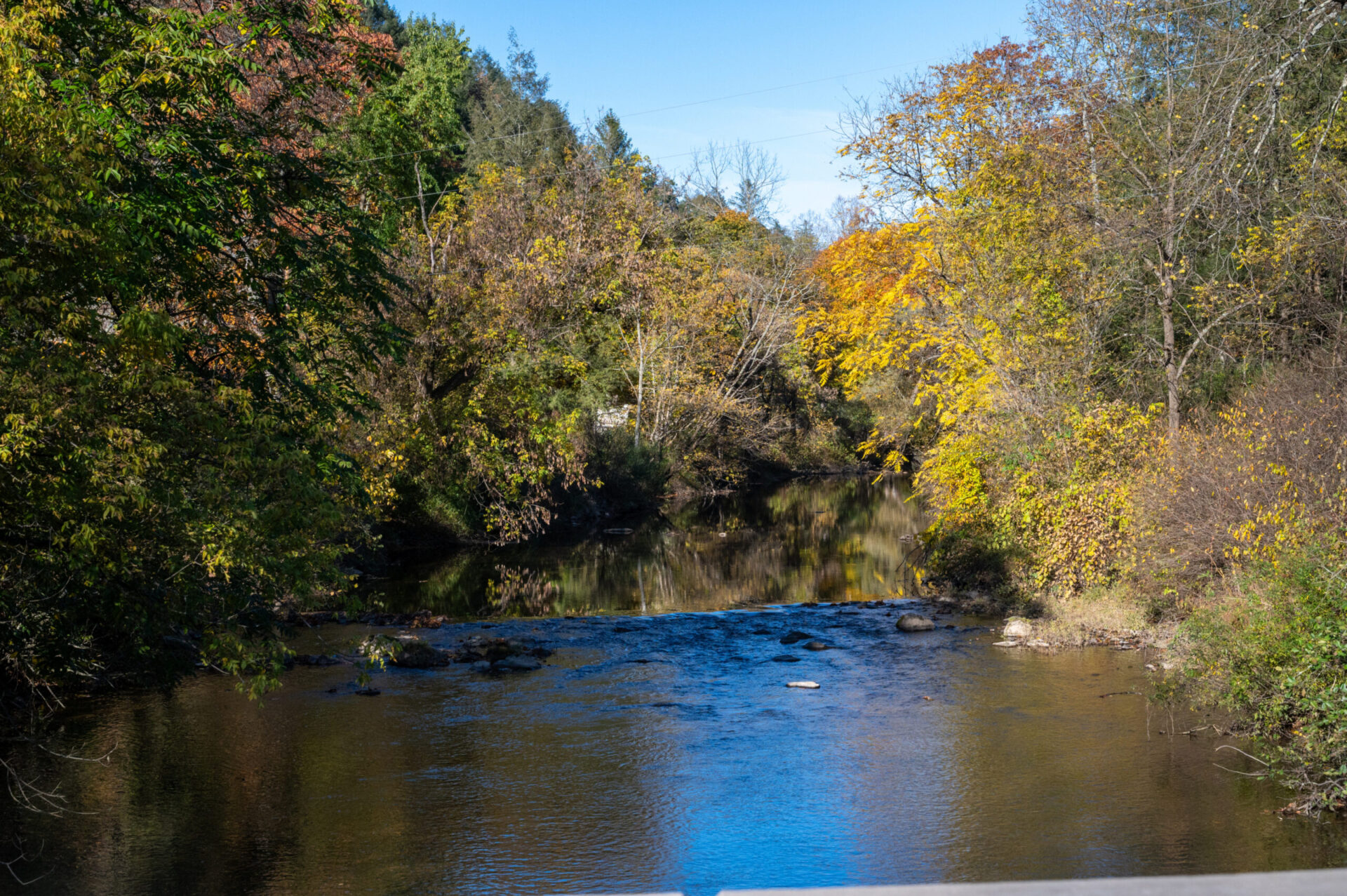
Photo by Bill Amos
Said landowner Steve Wojdylak, “My wife and I both feel that Ridge Farm has been heaven-on-earth for our family and friends and needs to be preserved. Thanks to Natural Lands for all your help.”
“ClearWater Conservancy was excited to collaborate with Natural Lands and the Wojdylak family to preserve this beautiful property in perpetuity,” said Elizabeth Crisfield, executive director of ClearWater Conservancy. “Maintaining habitat connectivity through forested ridgelines is an important contribution to climate resilience in central Pennsylvania, facilitating natural dispersal of native plants and animals. We look forward to continuing to work with the Wojdylaks and others in Huntingdon County.”
The project was supported through the Open Space Institute’s Appalachian Landscapes Protection Fund (ALPF), which supports the protection of climate resilient lands for wildlife and communities. The ALPF is made possible with a lead grant from the Doris Duke Foundation and with significant support from the Lyndhurst Foundation, the Richard King Mellon Foundation, Riverview Foundation, Tucker Foundation, Lookout Foundation, Footprint Foundation, Anonymous Foundation (2), as well as other foundations and individuals who understand the critical role that land protection plays in addressing the threats of climate change.
Natural Lands is dedicated to preserving and nurturing nature’s wonders while creating opportunities for joy and discovery in the outdoors for everyone. As the Greater Philadelphia region’s oldest and largest land conservation organization, Natural Lands—which is member supported—has preserved more than 135,000 acres, including 40+ nature preserves and one public garden totaling more than 23,000 acres. Nearly five million people live within five miles of land under the organization’s protection. Land for life, nature for all. natlands.org.
Please note: “Natural Lands” is the organization’s official operating name and should be used instead of its legal designation (Natural Lands Trust, Inc.).
ClearWater Conservancy is a nationally accredited land trust and conservation organization dedicated to the protection and restoration of Central Pennsylvania’s natural resources through land conservation, water resources stewardship, and environmental outreach across central Pennsylvania. Learn more at: clearwaterconservancy.org
Media Inquiries:
Natural Lands
Kit Werner, Senior Director of Communications
610-353-5587 ext. 267
kwerner@natlands.org
ClearWater Conservancy
Katie Molinengo, Communications Director
814-237-0400
katie@clearwaterconservancy.org
###